













What a Toronto wedding actually costs to move 50 to 300 guests
You picked the dress in December. You booked the venue in February. By April you have a florist, a photographer, a cake, and a string quartet for the ceremony.
Then in May you sit down to figure out wedding transportation, and four operators reply with “starting from” prices that are $1,800 apart. Two of them won’t give you a number until you give them your email and your venue. One quotes “$199 per hour.” The fourth says they’ll get back to you next week.
You suspect you’re being charged extra for not knowing what things should cost. You’re right. This article publishes the prices.
The Toronto wedding transportation market does something the wedding-cake market doesn’t. It hides its rates. Eight of the major Toronto operators reviewed for this piece either gate their pricing behind a quote form or publish a “from $X” floor with no ceiling. The result is a market where two couples planning the same 130-guest wedding can pay $4,800 and $6,900 for the same six hours of vehicles. That gap is not a service difference. It’s an information difference.
So here’s what your wedding should actually cost to move, by guest count, with real per-hour rates from a Toronto operator that publishes them.
The Toronto wedding fleet, with real per-hour rates
Every number below is pulled live from Chauffeuropolis’s published rate card. Add 13% HST and 15-20% gratuity on top of every number. Minimums are typically four hours within the GTA, five hours on the Sprinter tier.
– Executive sedan (Lexus ES, Cadillac XTS, Mercedes S-Class), 2 to 4 passengers: $100/hr or $1,000 for a 10-hour day
– Cadillac Escalade ESV, 5 to 6 passengers: $175/hr or $1,750/day
– Lincoln Navigator, GMC Yukon XL, or Suburban, 5 to 8 passengers: $165/hr or $1,650/day
– Mercedes Sprinter (14 passengers): $175/hr or $1,750/day
– Executive Sprinter (conference layout, 14 passengers): from $185/hr
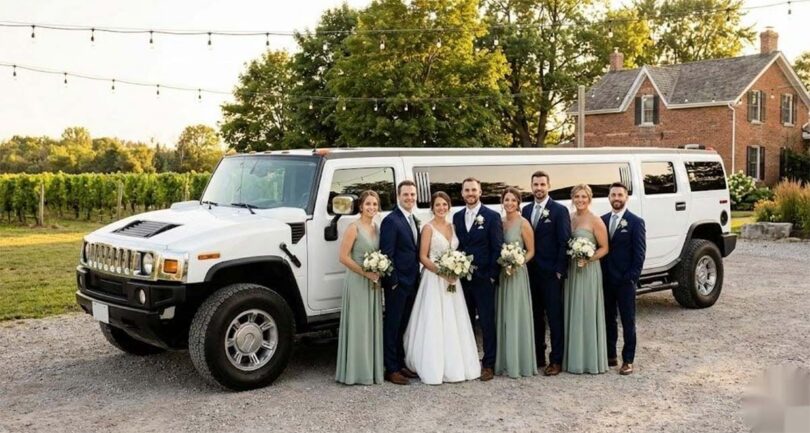
– Hummer H2 stretch limo, 16 to 20 passengers: $250/hr
– 27-seat mini coach: $250/hr
– 35-passenger party bus: $250/hr
– 52-seat coach (with washroom, luggage bays, power): $275/hr
– 58-seat motorcoach: $325/hr
– Rolls-Royce: $600/hr (for the couples who want the photograph)
Two notes on this list that matter more than the numbers themselves.
First, these are flat rates, not floors. No surge pricing at midnight when the reception runs late. No fuel surcharge on the contract. No late-night premium when other operators hike their rates after 11:00 PM.
Second, those rates are published. Walk into a quote call with a competing operator and they will quote you within $25 of these numbers. The four hidden fees you’ll find on the contract three weeks later (fuel, late-night, vehicle substitution, dispatch coordination) push the final bill 25 to 40% higher. That gap is the opacity tax. We’ll come back to it.
## What a 50-guest wedding costs
Small wedding. Most or all guests are local. The couple’s main decision is whether to book a getaway car for themselves and call it done, or add a small shuttle for grandparents and out-of-town family.
A 50-guest wedding with just the couple’s car runs about $1,150 all-in (Cadillac Escalade ESV, 5-hour minimum). Add a Mercedes Sprinter for 14 extended-family guests on a single hotel-to-venue loop and you’re at about $2,300 all-in.
Couples sometimes overbook here. A 50-guest wedding does not need a 35-passenger party bus. A six-hour Sprinter loop costs $1,050 pre-tax. A six-hour party bus costs $1,500 pre-tax. The party bus is $450 the couple paid for empty seats.
What a 100-guest wedding costs
The math changes at 100 guests because you typically have 30 to 50 out-of-town guests staying at one hotel. They are not driving themselves to your ceremony.
A workable build:
– Bride and groom car (Cadillac Escalade, 4 hours plus 1-hour photos): $700 pre-tax
– One 52-seat coach running two pickup loops plus a single return loop, 6 hours total: $1,650 pre-tax
Subtotal: $2,350 pre-tax. With HST and 18% gratuity, roughly $3,100 all-in.
This is the wedding size where most couples make the wrong call. They either book two smaller Sprinters because the per-hour rate looks lower, or they skip the guest shuttle entirely and let the room divide into “people who Ubered” and “people who carpooled in heels.”
Two Sprinters on a 6-hour wedding day costs $2,100. Each Sprinter only fits 14 guests. The math doesn’t work for 100 people in a single loop. One coach is cheaper, simpler, and faster.
What a 150-guest wedding costs
The most common Toronto wedding size, and the one where the $2,000 mistake actually shows up.
A reasonable build:
– Bride and groom car (Cadillac Escalade or Maybach, 6 hours): $1,050 pre-tax
– 58-seat motorcoach for the main guest shuttle, 6 hours: $1,950 pre-tax
– 27-seat mini coach for an early-run parents and grandparents schedule, 6 hours: $1,500 pre-tax
Subtotal: $4,500 pre-tax. With HST and 18% gratuity, about $5,930 all-in.
Two things going on in this number. One is that the two-vehicle setup (motorcoach for the late crowd, smaller coach for the early crowd) is what actually makes the wedding day work. Grandparents leave at 8:00 PM. The dance-floor crowd stays till 1:00 AM. One shuttle cannot do both. Couples who book one large coach and try to make it work end up paying for a third vehicle at the end of the night when the operator’s coach is already off-duty.
The other thing: $5,930 is the floor for a 150-guest Toronto wedding when you do it properly. Couples who Uber their guests instead of running a shuttle pay roughly $3,100 in guest Uber receipts (60 rides at an average of $52) plus typically $600 to $1,200 in venue overage when their guest arrival window stretches from 20 minutes to 90 minutes. So they “save” $5,930 on the budget and lose $3,700 to $4,300 elsewhere, plus pay it in stress.
What a 200-guest wedding costs
At 200 guests, the bridal-party transport problem shows up as a third vehicle.
– Bride and groom car (Cadillac Escalade, 6 hours): $1,050 pre-tax
– Two 58-seat motorcoaches for guest shuttle, two loops plus return (6 hours each): $3,900 pre-tax
– Mercedes Sprinter for the bridal party (6 hours): $1,050 pre-tax
Subtotal: about $6,000 pre-tax, or $7,900 all-in.
Couples often try to save here by booking three Sprinters instead of two coaches. The math: three Sprinters at $175/hr times 6 hours equals $3,150. That’s three drivers, three coordination points, and three vehicles that each only hold 14 passengers. Two coaches handle the same 200 guests in two loops with one dispatcher, one timeline, and one driver per route.
## What a 300-guest wedding costs (including the Muskoka destination case)
At 300 guests, transportation is one of the larger line items on the budget.
For a local 300-guest wedding (everything in the GTA):
– Bride and groom car (Cadillac Escalade or Hummer Stretch for the photo, 6 hours): $1,050 to $1,500 pre-tax
– Three 58-seat motorcoaches for the guest shuttle: $5,850 pre-tax
– Mercedes Sprinter for bridal party: $1,050 pre-tax
Subtotal: about $8,400 pre-tax, or $11,070 all-in.
For a destination Muskoka wedding (the JW Marriott Rosseau, Deerhurst, Sherwood Inn class of venue), the math changes substantially because of multi-day dedicated service.
A one-way Sprinter transfer from Toronto to the JW Marriott Rosseau runs $1,800 to $2,200 each direction. A round trip across two days is $3,600 to $4,400 per Sprinter.
There is a different pricing structure for the same vehicle if you book three consecutive days dedicated to the wedding party. The three-day window runs $2,800 to $3,200 total, including multiple shuttle runs.
That number, against $5,400 to $7,200 for three days of daily standby pricing, is a 40 to 55% discount. It exists because the operator’s vehicle is dedicated to one client for the whole period and the per-hour math gets re-blended. Most couples don’t ask for it because they’re shopping leg-by-leg instead of weekend-as-a-whole.
A 300-guest Muskoka destination wedding properly built (three motorcoaches doing the Toronto-to-Muskoka round trip, plus an Escalade on a 3-day dedicated rate for the couple) runs about $14,000 to $16,500 all-in. Yes, that’s a real number. Couples planning destination weddings should budget for it from month one.
The $2,000 mistake, named
The mistake is not the wedding size. It is not the vehicle choice. It is shopping in an industry where seven out of eight operators hide their prices, and accepting the consequence.
The opacity tax shows up in three ways across the wedding budget.
The first is vague quotes that turn into surprise invoices. Operators who quote “from $200/hr” can add fuel surcharges of 5 to 10% on trips over 100 km, late-night premiums after 11:00 PM, “vehicle staging” fees, dispatch coordination fees, and overtime billed at 1.5x in half-hour increments. A $2,400 base quote often invoices at $3,200 to $3,400. On a typical 150-guest wedding, that’s roughly $800 of pure opacity.
The second is resellers selling someone else’s fleet. A company that does not own the vehicle they quote you is reselling another operator’s bus. They mark up the underlying rate (typically 15 to 25%) and they cannot substitute a backup vehicle if the partner has a problem the night before. On a 6-hour booking, that markup is $300 to $600 you would not pay if you went directly to the operator who owns the bus.
The third is buying three vendors instead of one. A couple who books the bridal limo from one company, the guest shuttle from another, and the airport meet-and-greet from a third pays three minimums (typically 4 hours each, sometimes 5), three deposits, three sets of fuel-and-gratuity, and three coordination overheads. The same wedding day booked through one operator on a stacked contract typically runs 15 to 25% lower because the per-hour rates blend across vehicles and the minimums get satisfied once.
Add those three together at a 150-guest wedding and you are at $1,800 to $2,400 of money that has no business being on the invoice. That’s the $2,000 mistake.
Five questions that get you the real price
Most “questions to ask wedding vendors” lists are too polite. These five get you past the brochure language.
- Do you own the vehicle you would assign to my wedding? A one-word answer means you’re talking to the operator. A three-paragraph answer about “our trusted partner network” means you’re talking to a reseller. Both can do your wedding. Only one of them is the price floor.
- What is your all-in number including HST, gratuity, fuel surcharge if applicable, and overtime if my ceremony runs 30 minutes long? An operator who can answer this in one sentence has a transparent rate sheet. An operator who needs to “get back to you” is hiding fees.
- What is your backup vehicle policy if mine has a mechanical issue the night before? Real operators have a second vehicle on standby for wedding bookings and will tell you the model. Resellers will say they “have options” and “we’ll work it out.”
- Can you handle the bridal car, the guest shuttle, and the after-party return on one contract? If yes, ask for the blended-rate quote, not the legged-out quote. The bundled number is almost always lower.
- What is the difference between booking five hours and booking ten hours as a full-day charter? Most operators have a full-day rate that runs $10 to $15 per hour cheaper than the hourly equivalent. A Lincoln Navigator on a 10-hour wedding day is $1,650 (a $50 saving plus zero overtime risk) instead of $165/hr open-ended.
Toronto venue-specific costs that change the math
Where your wedding is matters as much as how many people are coming.
The Casa Loma drop
Public coach parking sits at the bottom of the hill. The walk up to the ceremony entrance is steep enough to wreck satin heels. Coaches need to drop at the upper Austin Terrace entrance, not the public lot, which means the operator needs to know the route. Many don’t. Ask before you book.
The Liberty Grand wing problem
Three separate event spaces inside one building (Artifacts, Centennial, Renaissance). The shuttle needs to know which space your reception is in. The wrong wing means guests walk through the parking lot in formal wear at 6:00 PM.
Niagara wine country logistics
Peller, Peninsula Ridge, Vineland Estates, Jackson-Triggs. 90 minutes from Toronto in normal traffic. 2 hours 20 minutes on a summer Saturday. The shuttle has to leave 45 minutes earlier than the math suggests. The return is not optional. Sixty guests who drank wine for six hours cannot drive home. A round-trip motorcoach in this scenario runs $1,950 to $2,400.
The Muskoka destination math
JW Marriott Rosseau, Deerhurst, Hockley Valley, Sherwood Inn. Highway 11 doubles its travel time on a July Saturday afternoon. A coach that leaves Toronto at 1:00 PM in February makes Muskoka in two hours. The same coach on a July Saturday takes four. Ceremony starts without your guests if you don’t build for it. This is also where the 3-day dedicated rate ($2,800 to $3,200) becomes the biggest single saving on the budget.
Blue Mountain in winter
Not every operator runs winter-rated tires for the mountain pass. Ask before you book a January wedding. Some operators substitute a lower-rated vehicle without telling you.
Tight loading windows downtown
Estates of Sunnybrook, Four Seasons Toronto, King Edward Hotel. Operators who have done these venues will mention the loading window on the first call. Operators who haven’t will be in the wrong lane for 15 minutes.
How to actually save the $2,000
Five practical moves, in order of dollar impact.
- Get the all-in number, not the base rate. Ask the operator to quote you the gross including HST, gratuity, fuel, overtime rules, deposit terms, and cancellation policy in one email. Operators who can do this in one reply are the ones who don’t surprise you on the invoice. Saves $400 to $800 on a typical 150-guest wedding.
- Book one operator for the whole day. Stacked contracts (bridal car, guest shuttle, parents van, airport meet-and-greet) bundle the minimums and blend the per-hour rates. Saves 15 to 25% versus three separate vendors. On a 200-guest wedding, that’s $1,100 to $1,800.
- Lock the full-day rate if you’ll use the car for 8 hours or more. A Lincoln Navigator at $165/hr times 8 hours is $1,320. The same Navigator on a 10-hour full-day rate is $1,650. If you’ll actually use the car for 9 hours or more, the full-day rate is cheaper per hour and it eliminates overtime surprise. Saves $200 to $500 on the wedding day.
- Right-size the fleet. Don’t over-book or under-book. A 50-guest wedding in a 35-passenger party bus is $450 of empty-seat overpay. A 130-guest wedding in two Sprinters is $700 of under-booking that ends in guest Ubers anyway. Match the vehicle to the actual headcount. The fleet grid at the top of this article is the math.
- For destination weddings, ask about the multi-day rate. A three-day Muskoka or Blue Mountain rate runs $933 to $1,067 per day versus $1,800 to $2,400 per day standby. If your wedding involves a Friday rehearsal dinner shuttle, a Saturday wedding-day shuttle, and a Sunday day-after brunch transfer, the three-day rate saves $2,000 to $4,000.
Booking the wedding with a Toronto operator that publishes its rates and runs all three legs of the day on one contract is the version of this service that prevents the $2,000 mistake. It is also the version that, until now, has not been priced openly on the Toronto market.
The real lesson
A wedding budget is mostly about choosing trade-offs you can live with. You decide between the dress you wanted and the dress that fit the number. You decide between the venue you fell in love with and the venue that had your date open.
Wedding transportation is the one line item where the trade-off is fake. There is no service difference between an operator who quotes $4,800 and an operator who quotes $6,900 for the same 150-guest wedding. There is only a transparency difference. One of them is showing you the real price. The other is building $1,500 to $2,100 of opacity tax into the invoice and waiting to see if you notice.
You don’t have to overpay. You just have to know what things cost.